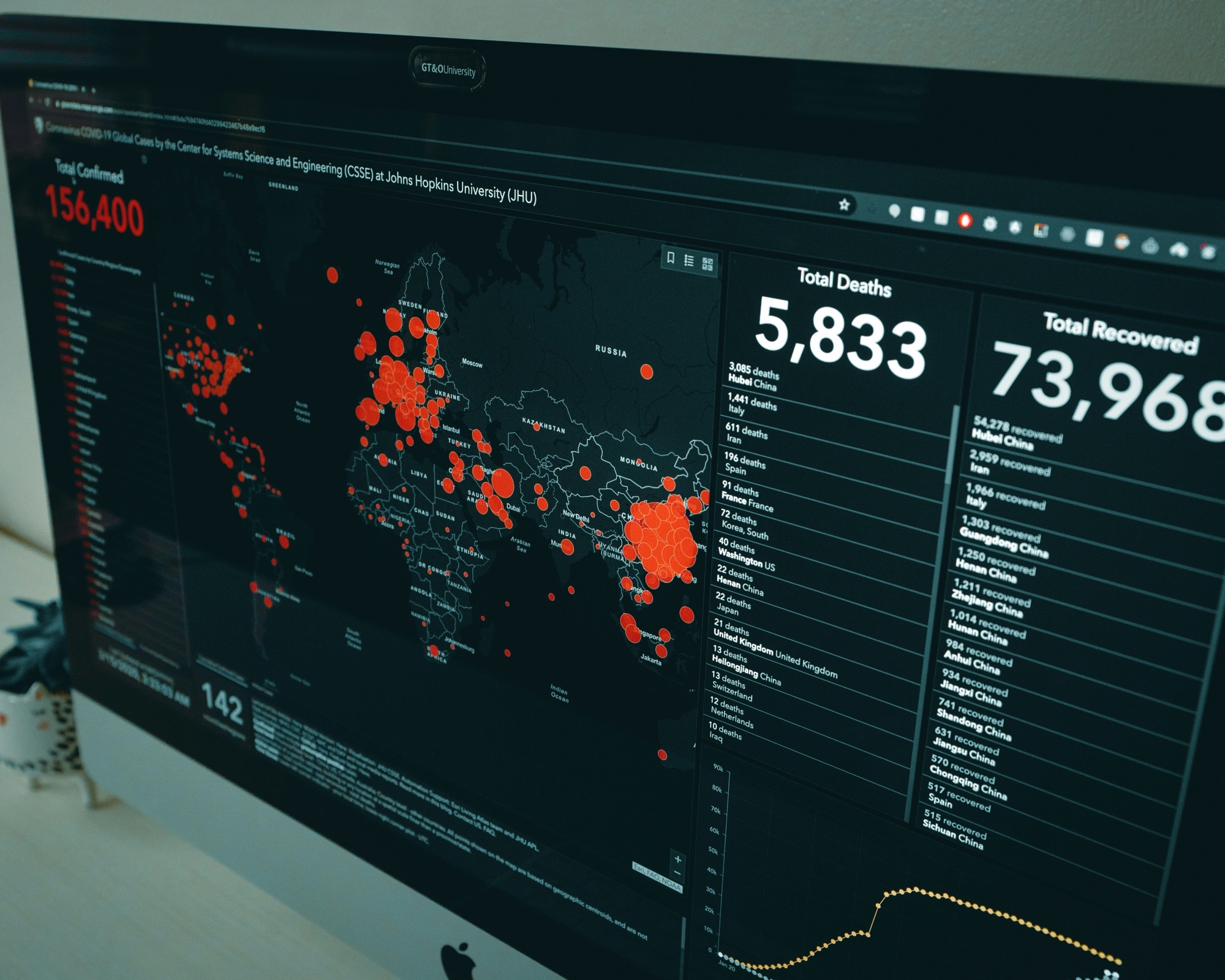
Summary: The United States has snuck in a few health data and pathogen-sharing requirements inside multi-billion-dollar bilateral aid agreements with several African governments. Critics are up in arms and they argue that this type of access gives Washington decades-long, unrestricted access to genomic databases, disease surveillance systems, and biological samples that will feed pharmaceutical pipelines, AI tools, and biocides planning with very little benefit to the people giving the data.
Featured Image: Clay Banks
There’s a sentence that’s buried inside the America First Global Health Strategy and you’d have to dig deep to find it. Craftily hidden among co-financing targets and disease surveillance frameworks is a clause that requires signatory African countries to share sensitive health data and pathogen samples with the U.S.
And this requirement sometimes stands for up to 25 years. Depending on which side you’re standing on, this is either a simple, reasonable condition for receiving billions in health funding, or it’s the sneakiest, most sophisticated data extraction deal that’s ever been paused to African nations.
By the end of February 2026, 18 African countries had taken the bait and signed these bilateral health agreements worth US$19.8 billion, with the involved African nations pledging US$7.5 billion of their own funds.
Signatories include Botswana, Nigeria, Kenya, Ethiopia, Uganda, Rwanda, and more. These are countries that collectively host some of the world’s most epidemiologically significant populations and disease landscapes.
What Are These Deals Exactly?
On the 18th of September, 2025, the U.S. government released its new America First Global Health Strategy, and this outlined five-year Memorandums of Understanding (MOUs) with partner countries in the 2026-2030 period. Since USAID has been scrapped with much controversy, this strategy was meant to replace USAID-channelled aid with direct bilateral compacts designed, in Washington’s framing, to help countries build ‘more resilient and durable health systems’ and stand on their own feet without depending on donors.
The logic was that the U.S. cuts aid, countries get to co-invest in their own health systems, and both parties get to share data and pathogens quickly.
Global health financing dropped 21% from 2024 to 2025 according to the Institute for Health Metrics and Evaluation, so in the context of governments who were already spending far below the 15% set in the 2001 Abuja Declaration, the deals were almost impossible to pass up.
Kenya was the first to sign in December 2025 and it agreed to a framework worth approximately US$2.5 billion. But in a twist, within a week, a Kenyan court suspended implementation because of data security concerns.
Other governments weren’t discouraged by this and by February 2026, 18 countries had signed and others were open to negotiations.
What Does the U.S. Get Out of This?
Africa’s health data has strategic value that goes beyond disease monitoring and the U.S. knows this.
Pathogen samples, genomic databases, and longitudinal electronic health records are inputs for AI tools, pharmaceutical pipelines, and security analytics that generate economic and strategic value far beyond Africa, according to researchers at the Centre for Global Health Law at Warwick University and KELIN, a Nairobi-based health rights organization, writing in PLOS Global Public Health.
Nelson Aghogho Evaborhene, a PhD Fellow in Global Health Governance at Roskilde University in Denmark, said it quite plainly: pathogen data is what underpins the entirety of the biomedical innovation pipeline. “Countries and companies that had early access to viral sequences were able to move first on vaccines and intellectual property,” he told The Africa Report.
The COVID-19 pandemic was proof of this. The countries that held early genomic sequence data acted faster, filed more patents, and kept more of the commercial benefits that came as a result.
Evaborhene also noted the national security dimension. “Access to pathogen and surveillance data is no longer just a public health issue, but is now tied directly to biosecurity, pharmaceutical innovation, and strategic advantage. It feeds into preparedness systems, military bio-defence and strategic planning,” he said. (The Africa Report)
The U.S. also has historical precedent to draw on. PEPFAR, the President’s Emergency Plan for AIDS Relief, has operated across sub-Saharan Africa since 2003, funding health infrastructure including laboratories, electronic medical records, and disease surveillance networks.
Those systems, which were built largely using American money, have generated huge datasets and there have been questions about who owns these data sets and benefits from them.
The Clause That Changed Everything
The most controversial part of the bilateral agreements is a data and pathogen-sharing obligation that somehow outlasts the actual MOUs.
Professor Oyewale, a former WHO regional virologist, made a very frank assessment. Writing in The Conversation Africa, he states that a unilateral termination clause which gives Washington the permission to pause or end programs that no longer benefit U.S. government interests reduces the sovereign partners to dependent states, contrary to claims of helping African nations become independent:
“In particular, this US agreement has a unilateral termination clause that may leave African countries dangling on the tattered and shredded sovereignty of a beggar nation. On no account should Africa give raw data or pathogens for any amount of money or donation.”
Ravi Ram from the People’s Health Movement, East and South Africa, pointed out the structural imbalance: “Bilateral agreements between the US and Kenya and other African countries are meant to limit the ability of any one partner country to challenge the terms of implementing the agreement, due to the unequal power relations.” (AllAfrica)
Which Countries Are Pushing Back, and Why
Zimbabwe, to the surprise of its citizens, rejected a deal worth $367 million over five years in late February 2026. The government cited data-sharing concerns and what it described as asymmetrical terms.
The refusal was also connected to WHO Pathogen Access and Benefit-Sharing negotiations. There was an argument that signing bilaterally would unavoidably lead to African solidarity being undermined in multilateral forms.
The consequences of this decision were immediate. 1.2 million men, women, and children receiving their HIV treatment and medication via U.S. donor programs were faced with a funding vacuum and there was some panic about medication shortages.
Zambia dragged its feet after reports emerged (which Reuters said tied the deal to a ‘bilateral compact’ linked to mining collaboration proposed by Secretary Rubio), but the Zambian government stuck to its claims that there was no connection between the agreement and mineral deposits. Some civil society actors said that the data only flowed in one direction, from Zambia to the U.S. with no reciprocation.
While Kenya’s Principal Secretary of Medical Services, Oluga Ouma, assured media the MOU contained no pathogen-sharing clauses, clause 3 of the document commits the country to exactly that. A court suspension was ordered, but it was still unclear if it would have a practical effect.
Africa CDC’s Response
The response from the Africa Centers for Disease Control and Prevention has been strategic. Director-General Jean Kaseya had launched the Africa Health Security and Sovereignty Agenda in November 2025, calling it “non-negotiable” (a new model in which African nations lead partnerships with clarity and confidence). Two months after that, 18 member states signed agreements that clearly contradicted that very agenda. (ICTworks)
When Kaseya spoke at a virtual press conference in February 2026, he was quite direct about the stakes: “There are huge concerns regarding data, regarding pathogen sharing. We want to own our data in Africa. We want to own our future.” (Reuters via US News)
But Kaseya refused an offer to serve as an observer during the bilateral negotiations, and his reason was respect for national sovereignty. He also still pledged technical support to every member state regardless of whatever choice they made. This is a position that clearly reflects the limits of an advisory body that operates without binding authority over 55 sovereign nations:
“What we say to all African countries is negotiate based on your interest, policies and on the benefit that your country and the continent are getting.”
The Scramble for Pathogens: A New Extractive Economy?
Warwick University researchers Sharifah Sekalala, Shajoe J. Lake, Allan Maleche, and Timothy Wafula, writing in PLOS Global Public Health, have put forward strong arguments. They argue that what is happening is a structural reconfiguration of data ownership posing as partnership. They argue that this is all a farce. “Race is crucial to this arrangement,” they write. “Countries such as Kenya, Rwanda, and Uganda are asked to trade health data and pathogens for funding under the language of partnership, while the principal gains from expanded surveillance capacities, patent portfolios, and AI tools continue to accrue to the US and its allied markets.” (PLOS Global Public Health)
They argue that the communities that generate the data are highly unlikely to hold intellectual property, shape research agendas, or reliably access the resulting products or rewards. This pattern is not new to Africa. Raw materials are extracted, and the value is added elsewhere.
Citizens have been appealing to their governments and more than 50 civil society organizations published an open appeal urging African governments not to sign agreements that they described as designed to “dictate US terms that are not guided by African national interests”. (AllAfrica)
What Happens When the Money Runs Out?
The bilateral agreements also raise a structural problem that African health ministries are only beginning to grapple with. Some countries, such as Liberia, could face significant year-over-year drops in U.S. funding alongside sharp increases in co-financing expectations that exceed previous spending projections, according to analysis by the Council on Foreign Relations’ Think Global Health.
In 2025, Nigeria’s Health Minister publicly confirmed that only about US$25,797 (₦36 million) of the ₦218 billion capital allocation for the Ministry of Health Headquarters was actually released for capital projects. The figure, confirmed by Minister Muhammad Ali Pate during his 2026 budget defence before the House of Representatives, refers to the Ministry’s Headquarters capital line — not the entire ₦2.38 trillion national health budget. Even so, it illustrates the chronic gap between what is allocated and what reaches the health system. Under the new bilateral framework, Nigeria must commit to a progressively increasing co-investment schedule from 2026 to 2030. The co-financing requirement is a legitimate long-term goal; in practice, for a country spending well under 6% of its budget on health, it is close to impossible to meet.
But let’s not ignore that African governments have been more resilient than expected. Nigeria increased domestic health allocations by US$200 million within a month of Trump’s aid cuts; Ghana removed the cap on its National Health Insurance Levy to redirect full proceeds into the health sector. These moves signal a continent that is gradually taking ownership of its own future.
So, Why Is the U.S. Really Interested?
The official answer is pandemic preparedness, global health security, and the responsible transition away from aid dependency. None of that is false. Early access to pathogen data genuinely accelerates response time. Building African lab capacity genuinely serves global biosecurity. The U.S. is not simply manufacturing a pretext.
But the unofficial answer, the one that civil society groups, virologists, and African health officials are now saying loudly, is that health data is a strategic asset, and the U.S. is using leverage it already holds (existing aid infrastructure, the threat of funding withdrawal) to lock in access before the rules of the game change at the WHO.
The bilateral agreements are, among other things, a way to pre-empt the WHO Pathogen Access and Benefit-Sharing mechanism adopted in 2025’s Pandemic Agreement. They pose significant risks to the ongoing negotiations on that mechanism by replacing multilateral rules with bilateral arrangements the U.S. can terminate at will, in Professor Tomori’s assessment.
The irony is sharp. A strategy framed around African self-reliance is, in its data clauses, engineering the opposite: a continent that generates the world’s most epidemiologically valuable data, but does not own it, cannot monetize it, and may not even be able to access the research it funds.
“We want to own our data in Africa. We want to own our future. — Jean Kaseya, Director-General, Africa CDC”
Sources & Further Reading
• The Africa Report — Africa slams the door on extractive US health deals
• KFF Tracker — America First MOU Bilateral Global Health Agreements
• Think Global Health — Tracking the America First Bilateral Health Agreements
• ICTworks — African Digital Health Data Is a Condition of Global Health Funding
• Health Policy Watch — December Deals: US Signs Bilateral Health Agreements With 14 African Countries
• ODI — African leadership amid disruptions to US aid
• Public Citizen — Letter to African Heads of State on Health Agreements (PDF)
• AllAfrica — America First Global Health Strategy: A Framework for Co-Opting Healthcare in Africa?
Leave a Reply