A group of men break into your home and brandish machetes in your face. They rob you blind. You walk to the police station, hands shaking, and you report the crime. There’s a short-lived pause before one of the police officers says, “Give us money for fuel and drinks before we can attend to you. If you can’t do that, go and bring the perpetrators yourself.”
Now let’s switch scenes for a moment.
Marisela crossed the US-Mexico border on a tourist visa in 2019. By 2022 her status had lapsed, but she had been living in Houston, working, paying rent, keeping to herself. Then she was assaulted. She called a friend, not the police. She knew what calling the police meant for someone like her: a conversation about her documents before a conversation about what had happened to her. The man who assaulted her went on to assault someone else in the same building six weeks later. She found out later from a neighbour. She did not go back to the police.
Her calculation was rational. A 2025 KFF/New York Times survey found that 41% of all immigrants, not just undocumented ones, personally worried that they or a family member could be detained or deported. When three quarters of a population are afraid a call for help might result in their deportation, the phone stays in the pocket. The perpetrator stays on the street.
What Exactly Is a Smart Police Station?
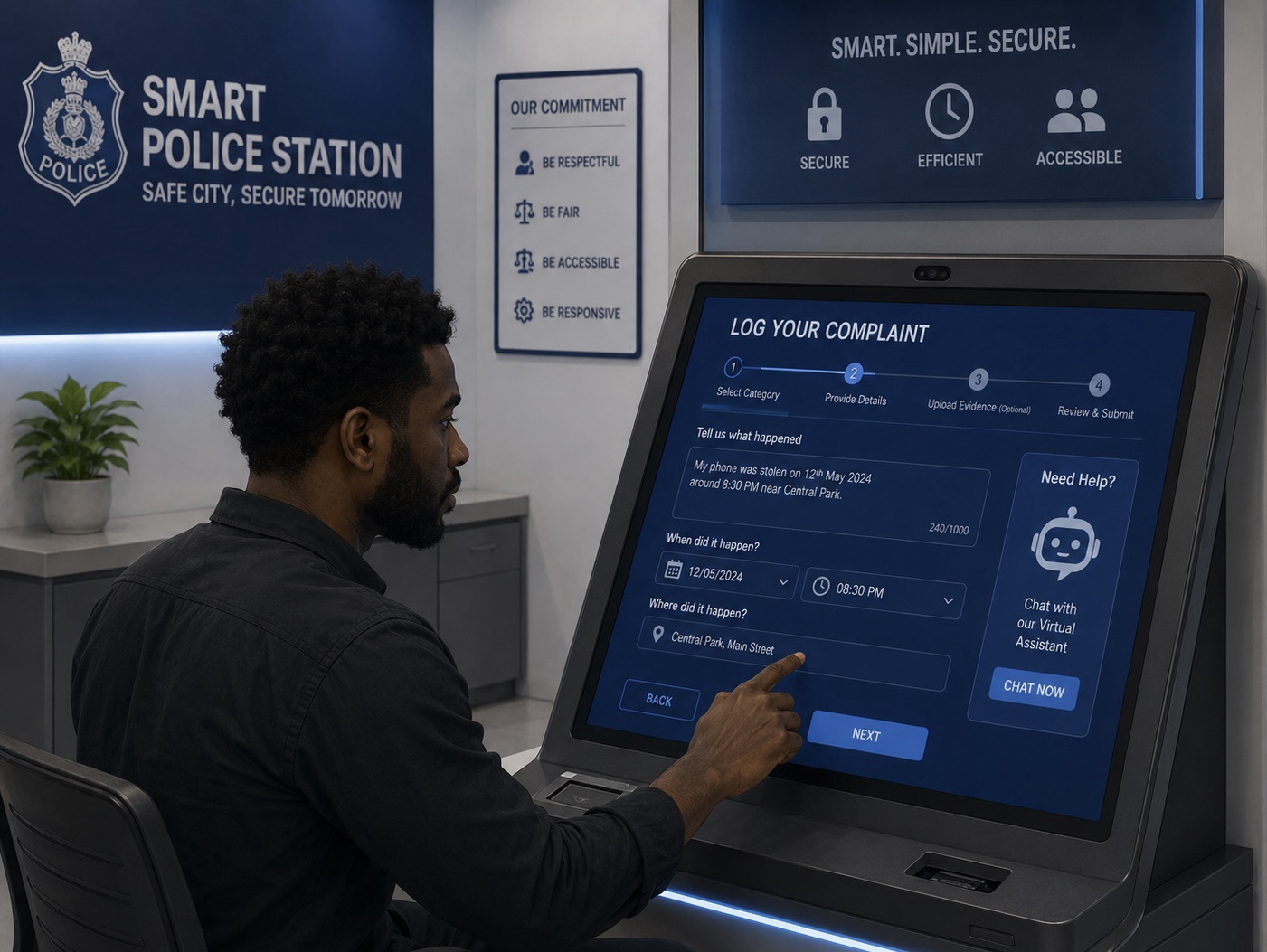
A smart police station is a digitally integrated law enforcement facility, fully or partially unmanned, where citizens interact with systems rather than front-desk officers. At its minimum, it is a self-service kiosk platform with guided digital workflows. At its maximum, it is a fully autonomous facility with AI-driven cameras, biometric identity verification, cloud-based case management, and real-time video links to remote command rooms.
The concept merges e-government infrastructure, public safety technology, and (whether the architects admit it or not) corruption-by-design prevention. When there is no officer standing between a citizen and the system, there is no palmed-form moment or prejudice. The leverage point simply doesn’t exist.
The shift in policing philosophy underneath all of this is from reactive to proactive. It’s from ‘respond after crime’ to ‘prevent, detect, and document in real time.’ That shift requires data infrastructure. And data infrastructure, it turns out, is also the best accountability system humans have yet devised.
How It Actually Works: The Technical Architecture
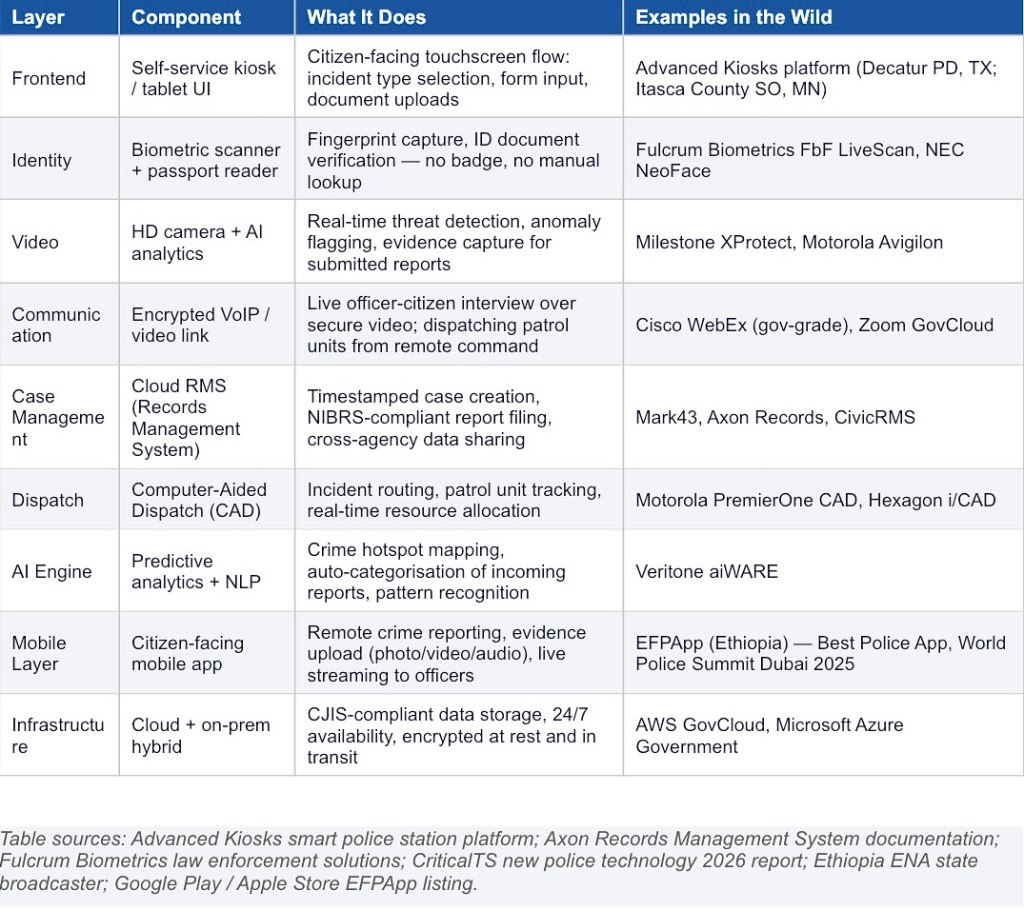
A smart police station is a layered stack of integrated systems. Here is what that stack looks like, and what each component does in practice:
The Citizen Journey
Step 1: Walk In (or Open the App).
The citizen approaches a partitioned booth with a touch-enabled tablet screen, or opens a mobile app. There is no queue. There is no uniformed person to negotiate with.
Step 2: Incident Classification.
The interface presents categorised incident types: theft, assault, traffic incident, financial fraud, missing person, lost documents, and so on. CAD systems (Computer-Aided Dispatch) sit behind this layer. The moment an incident type is selected, the system begins creating a structured incident record linked to location, time, and category.
Step 3: Identity Verification.
Biometric scanners, typically FBI-certified fingerprint capture devices or passport/ID readers, verify the citizen’s identity without manual document handling. This creates an immutable link between the report and a verified identity, which is both a fraud deterrent and an evidentiary asset.
Step 4: Evidence Submission.
The system accepts structured digital input: typed statement, photo upload, video, audio recording, and GPS location tagging. In the EFPApp mobile version, live streaming to the remote command room is available, essentially a direct video link to an officer in real time.
Step 5: Remote Officer Review.
Once submitted, a remote officer receives the report on a dashboard, flagged by incident type and AI priority scoring. For in-station kiosks, the officer appears on screen via encrypted video link, takes the statement verbally, asks follow-up questions, and if the situation warrants immediate response, dispatches patrol units. In Ethiopia’s Bole station, this entire interaction can happen in under ten minutes.
Step 6: Case Record Creation.
The report is automatically filed into the cloud-based Records Management System (RMS) with a timestamp, case number, and unique identifier that is visible to the submitting citizen. The record is immutable, it cannot be deleted by a single officer. It is cross-referenced with the national criminal database (NCIC/NLETS in the US; equivalent national registries in other jurisdictions). The fold-and-pocket manoeuvre is architecturally impossible.
The Problem Smart Stations Are Solving (With Numbers)
The Global Corruption Barometer (Africa) from Transparency International estimated that nearly 75 million people in Sub-Saharan Africa paid a bribe in a single year to access public services, and of the six public services surveyed, police contact had the highest bribery rate. An estimated one-in-ten bribery victims actually reported it.
Nigeria’s Global Corruption Barometer entry records that 44% of public service users paid a bribe in the previous twelve months. These statistics describe the modal experience of interacting with law enforcement across much of the continent.
When reporting feels futile, victims don’t report. When crimes go unreported, perpetrators are not prosecuted. When perpetrators are not prosecuted, the incentive structure for crime remains intact.
Smart stations address the structural problem, not just its symptoms. Removing the human intermediary at the point of first contact removes the opportunity for dishonesty from the interaction entirely.
The Problem Is Not Only African
The narrative around smart policing and digital crime reporting tends to get filed under ‘developing world governance reform’, a frame that lets wealthier nations off the hook. The data does not support that framing. The US, the UK, and Western Europe have their own versions of the broken reporting loop, driven by different mechanisms but producing the same result: vast numbers of crimes that never enter the system, and perpetrators who stay free because victims had no realistic expectation of being helped.
The Underreporting Problem in the United States
According to RAINN, only 310 out of every 1,000 sexual assaults are reported to law enforcement. Nearly seven in ten survivors of sexual violence never file a report. The reasons are consistent across surveys: fear of retaliation, disbelief that police will act, shame, and fear of how the criminal justice system will treat them.
Why Smart Stations Address This Too
The architectural argument that applies to the first case applies equally to the second (Marisela), to the sexual assault survivor standing at a public counter, to any person whose decision about whether to report is shaped by what the officer behind the desk might do with their presence, their status, or their identity.
A private booth with a timestamped digital submission does not ask about immigration status before opening a case. A remote officer receiving a report with the record already in the system has less opportunity and less incentive to let the conversation detour into territory unrelated to the crime. The immutable RMS record is as protective in Houston as it is in Addis Ababa: once it exists, it cannot be folded away. The accountability pressure runs both directions.
This is not a claim that technology resolves structural racism, immigration enforcement policy, or decades of institutional distrust. It is a narrower, more defensible claim: removing the unmediated human interaction at the point of first contact removes one specific leverage point where vulnerable people are most exposed to the worst institutional outcomes. A system that logs every interaction, and makes that log visible to the submitting citizen, applies accountability pressure before the complaint reaches a human officer. It does not fix everything. It fixes something specific, something measurable, and something that affects millions of people in the wealthiest democracies on the planet, not just in Africa.
Ethiopia Steps Into History
On February 9, 2026, Prime Minister Abiy Ahmed inaugurated Africa’s first fully unmanned smart police station in Addis Ababa’s Bole district, a commercial hub that functions roughly like a mid-tier African tech corridor. This is the fourth unmanned smart police station of its kind anywhere in the world.
The project was developed in collaboration with the Ethiopian Artificial Intelligence Institute (EAII), which has been embedded in several of Ethiopia’s digital governance initiatives and is also responsible for the EFPApp (more on that shortly). The initiative sits within Ethiopia’s Digital Ethiopia 2030 strategy, a national blueprint targeting the digitisation of public institutions, improved service delivery, and technology-mediated access to government.
According to Ethiopia’s state broadcaster ENA, the system runs 24/7/365 — no shift changes, no overnight staffing gaps, no ‘come back tomorrow.’ In its first week of operation, it received three reports: a lost passport and two financial fraud cases. Modest for a launch week. Proof of concept, technically speaking.
The EFPApp: Smart Policing in Your Pocket
Alongside the physical station, Ethiopia has been building the mobile layer. The EFPApp, developed by EAII for the Ethiopian Federal Police, is a citizen-facing crime reporting application available on both Google Play and the Apple App Store. Its feature set is worth reading in detail, because it illustrates what mobile-layer smart policing actually looks like at an engineering level:
- Live streaming — stream video from your phone directly to the police in real time
- Evidence upload — attach photos, videos, documents, or audio recordings to a report
- Location sharing — GPS tagging with directions to the nearest police station or safe location
- Report tracking — a case dashboard showing the status of submitted reports through investigation and prosecution
- Free emergency calls — dial 991 directly from within the app at no charge
In May 2025, the EFPApp won first place in the Best Police Mobile Application category at the World Police Summit in Dubai, an international competition evaluated on innovation, design, technology, and real-world impact. The EFPApp currently serves Addis Ababa and Dire Dawa.
Why This Technology Architecture Matters
The Accountability Architecture of a Timestamped Record
The most powerful thing a smart police station does is adding the timestamp. When a complaint enters a NIBRS-compliant RMS, that is, a records system conforming to the FBI’s National Incident-Based Reporting System standard, or its regional equivalent, it becomes an immutable entry in a shared database. Cross-agency queries are possible. The record can be retrieved by prosecutors. It has an author trail. A deletion or modification is itself logged.
This is the structural intervention that bribe culture cannot survive. Corruption in police reporting happens in the gap between citizen and system, in the moment of verbal transaction. Close the gap with software and you close the opportunity.
Privacy, Bias, and the Responsible Use Problem
A fair technical write-up does not ignore the risks. AI use in law enforcement has a known and documented bias problem: facial recognition systems trained predominantly on lighter-skinned faces perform worse on darker-skinned individuals, a disparity that has led to wrongful identification events. Predictive policing models trained on historically biased arrest data risk encoding and amplifying existing discrimination. The US Department of Homeland Security’s 2025 AI Use Case Inventory reflects growing federal recognition that AI in public safety requires structured minimum-risk management practices, not just deployment guidance.
In the African context, there is an additional concern specific to smart policing deployments: biometric data (fingerprints, facial scans, ID records) is being collected by government systems with, in many jurisdictions, limited independent oversight of how it is stored, shared, or used. The accountability infrastructure that prevents corruption at the front desk has to be matched by accountability infrastructure that prevents surveillance overreach at the back end. One without the other is just a different problem wearing better optics.
A Station Where Your Voice Actually Counts
What Ethiopia has built in Bole is a proof of concept that accountability can be designed into the architecture of a public institution, and it’s unfortunate that we haven’t been designing it that way all along. The corruption point does not merely become harder to act on, the system makes it structurally inaccessible. The timestamp is automatic. The case number is generated on submission. The remote officer is watching. The record cannot be quietly folded and pocketed.
The question now is how to engineer for the inclusion gap: mobile-first interfaces with offline capability, kiosk UX designed for low-digital-literacy users, and biometric systems trained on the populations they serve.
Sources & References
1. Transparency International — Global Corruption Barometer Africa (9th Edition)
2. Transparency International — Police corruption in Africa
3. Transparency International — Corruption Perceptions Index 2025: Sub-Saharan Africa
4. Governance journal (Wiley) — Police bribery and crime rates: Afrobarometer study
5. ENA (Ethiopian state broadcaster) — PM Abiy launches smart police station
6. ENA — Smart Police Station features and 24/7 operation
7. ChimpReports — Ethiopia introduces digital police stations without officers
8. Ethio Negari — Ethiopia launches first unmanned smart police station
9. WutsHot — Ethiopia pilots smart police stations, Commander Demissie Yilma
10. Open The Magazine — Ethiopia’s smart police station: connectivity challenges
11. MEXC News / Technext — Ethiopian AI Institute collaboration detail
12. AllAfrica — EFPApp selected Best Police Application, World Police Summit 2025
13. Ethiopian Police University — EFPApp wins Best Police Mobile App, Dubai summit
14. Google Play / Apple App Store — EFPApp feature listing
15. Axon — Police RMS: complete guide
16. Advanced Kiosks — Smart Police Station platform (Decatur PD, Itasca County SO)
17. PSPortals — Police department software guide 2026 (Mark43, CivicRMS, PremierOne)
18. GlobeNewswire / Research and Markets — Law enforcement software market: $33B by 2030
19. Veritone — Modern police technology tools and trends
20. Critical TS — New police technology 2026 (AI video analytics, LTE/5G, FirstNet)
21. Police Records Management (PRI) — State of AI in law enforcement records 2025
22. DHS — 2025 AI Use Case Inventory (minimum risk management practices)
23. Fulcrum Biometrics — Biometrics in law enforcement: LiveScan and ID verification
Leave a Reply